Overview
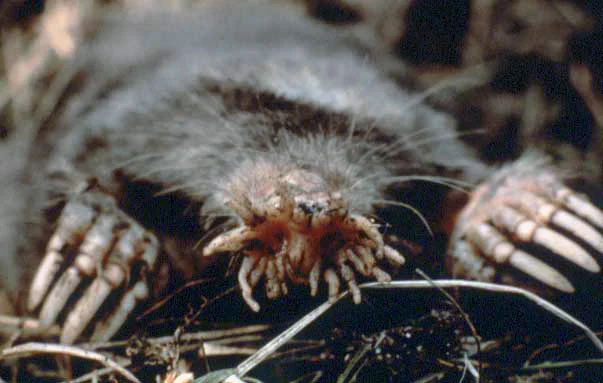
The star-nosed mole (Condylura cristata) is a small semiaquatic mole found in moist, low elevation areas in the northeastern parts of North America. It is the only extant member of the tribe Condylurini and genus Condylura. It has more than 25,000 minute sensory receptors in touch organs, known as Eimer's organs, with which this hamster-sized mole feels its way around. With the help of its Eimer's organs, it may be perfectly poised to detect seismic wave vibrations.
The nose is about 1.5 cm (0.59 in) in diameter with its Eimer's organs distributed on 22 appendages. Eimer's organs were first described in the European mole in 1872 by German zoologist Theodor Eimer. Other mole species also possess Eimer's organs, though they are not as specialized or numerous as in the star-nosed mole. Because the star-nosed mole is functionally blind, the snout was long suspected to be used to detect electrical activity in prey animals, though little, if any, empirical support has been found for this hypothesis. The nasal star and dentition of this species appear to be primarily adapted to exploit extremely small prey. A report in the journal Nature gives this animal the title of fastest-eating mammal...
The nose is about 1.5 cm (0.59 in) in diameter with its Eimer's organs distributed on 22 appendages. Eimer's organs were first described in the European mole in 1872 by German zoologist Theodor Eimer. Other mole species also possess Eimer's organs, though they are not as specialized or numerous as in the star-nosed mole. Because the star-nosed mole is functionally blind, the snout was long suspected to be used to detect electrical activity in prey animals, though little, if any, empirical support has been found for this hypothesis. The nasal star and dentition of this species appear to be primarily adapted to exploit extremely small prey. A report in the journal Nature gives this animal the title of fastest-eating mammal...
Sounds
A verified sound recording has not been linked yet. Auto Sync will keep checking xeno-canto and Wikimedia Commons.
References
- GBIF Auto Sync GBIF
- Wikipedia — Star-nosed mole Wikipedia
No published comments yet.