Overview
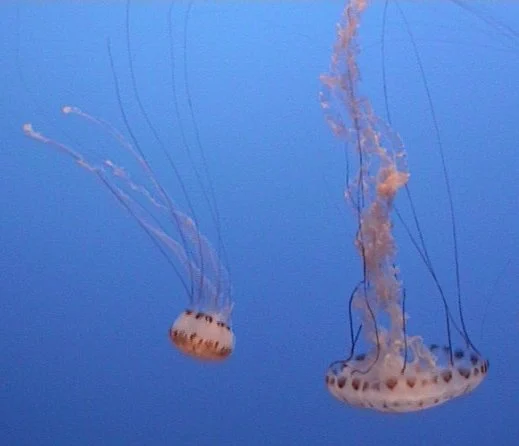
Pelagia noctiluca is a jellyfish in the family Pelagiidae and the only currently recognized species in the genus Pelagia. It is typically known in English as the mauve stinger, but other common names are purple-striped jelly (causing potential confusion with Chrysaora colorata), purple stinger, purple people eater, purple jellyfish, luminous jellyfish and night-light jellyfish. In Greek, pelagia means "(she) of the sea", from pelagos "sea, open sea"; in Latin noctiluca is the combining form of nox, "night", and lux, "light"; thus, Pelagia noctiluca can be described as a marine organism with the ability to glow in the dark (bioluminescence). It is found worldwide in tropical and warm temperate seas, although it is suspected that records outside the North Atlantic region, which includes the Mediterranean and Gulf of Mexico, represent closely related but currently unrecognized species.
A fairly small and variably coloured species, both its tentacles and (unusual among jellyfish) bell are covered in stinging cells. Stinging incidents are common, painful and the symptoms may continue for a considerable time after the encounter, but they are generally not dangerous. When large numbers of...
A fairly small and variably coloured species, both its tentacles and (unusual among jellyfish) bell are covered in stinging cells. Stinging incidents are common, painful and the symptoms may continue for a considerable time after the encounter, but they are generally not dangerous. When large numbers of...
Habitat & distribution
Habitats
Marine
Video
Sounds
Pronunciation in English of "purple drank". Male, Australian accent.Commander Keane · CC BY-SA 4.0
References
- Wikipedia — Pelagia noctiluca Wikipedia
- GBIF Auto Sync GBIF
- WoRMS / Aphia World Register of Marine Species
No published comments yet.