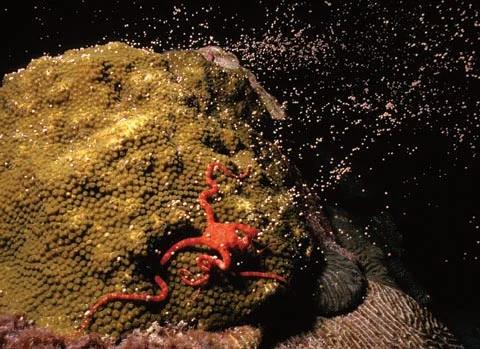
Porites is a genus of stony coral; they are small polyp stony (SPS) corals. (Also referred to as finger coral or hump coral) They are characterised by a finger-like morphology. Members of this genus have widely spaced calices, a well-developed wall reticulum and are bilaterally symmetrical. Porites, particularly Porites lutea, often form microatolls.
Porites is a genus of stony coral; they are small polyp stony (SPS) corals. (Also referred to as finger coral or hump coral) They are characterised by a finger-like morphology. Members of this genus have widely spaced calices, a well-developed wall reticulum and are bilaterally symmetrical. Porites, particularly Porites lutea, often form microatolls. Corals of the genus Porites also often serve as hosts for Christmas tree worms (Spirobranchus giganteus).
Video
Additional File 1
Red fluorescent invertebrates . Short MPG video clip showing examples of strongly fluorescent invertebrates and plants. Sequence 1a: Calcareous alga ( Amphiroa ) under normal viewing conditions (field at ca. 18 m depth, using Sony HD HDR-CX6EK, natural daytime illumination, no filter). Sequence 1b: Calcareous alga ( Amphiroa ) showing red fluorescence (field at ca. 18 m depth, using Sony HD HDR-CX6EK, natural daytime illumination, red filter, not post-processed). Sequence 2a: Unidentified alga under normal viewing conditions (field at ca. 18 m depth, using Sony HD HDR-CX6EK, natural daytime illumination, no filter). Sequence 2b: Unidentified alga showing strong red fluorescence (field at ca. 18 m depth, using Sony HD HDR-CX6EK, natural daytime illumination, red filter, not post-processed). Sequence 3a: Soft coral (or retracted anemone) under normal viewing conditions (field at ca. 18 m depth, using Sony HD HDR-CX6EK, natural daytime illumination, no filter). Sequence 3b: Soft coral (or retracted anemone) showing red fluorescence (field at ca. 18 m depth, using Sony HD HDR-CX6EK, natural daytime illumination, red filter, not post-processed). Sequence 4a: Stony coral ( Mycedium ) under normal viewing conditions (field at ca. 18 m depth, using Sony HD HDR-CX6EK, natural daytime illumination, no filter). Sequence 4b: Stony coral ( Mycedium ) showing red fluorescence (field at ca. 18 m depth, using Sony HD HDR-CX6EK, natural daytime illumination, red filter, not post-processed). Sequence 5a: Stony coral (unknown) under normal viewing conditions (field at ca. 16 m depth, using Sony HD HDR-CX6EK, natural daytime illumination, no filter). Sequence 5b: Stony coral (unknown) showing red fluorescence (field at ca. 16 m depth, using Sony HD HDR-CX6EK, natural daytime illumination, red filter, not post-processed). Sequence 6: Anemone Entacmaea quadricolor showing red fluorescence (field at ca. 18 m depth, using Sony HD HDR-CX6EK, natural daytime illumination, red filter, not post-processed). Sequence 7a: Polychaete worm ( Sabellastarte indica ) under normal viewing conditions (field at ca. 18 m depth, using Sony HD HDR-CX6EK, natural daytime illumination, no filter). Sequence 7b: Polychaete worm ( Sabellastarte indica ) showing red fluorescence (field at ca. 18 m depth, using Sony HD HDR-CX6EK, natural daytime illumination, red filter, not post-processed). Sequence 8: Red reef fluorescence as it appears when viewing the reef through a red mask. Most fluorescent structures are either stony corals or algae (field at ca. 18 m depth, using Sony HD HDR-CX6EK, natural daytime illumination, red filter, not post-processed).Credit: Michiels N, Anthes N, Hart N, Herler J, Meixner A, Schleifenbaum F, Schulte G, Siebeck U, Sprenger D, Wucherer M · CC BY 2.0Source ↗
Sounds
A verified sound recording has not been linked yet. Auto Sync will keep checking xeno-canto and Wikimedia Commons.
No published comments yet.