Overview
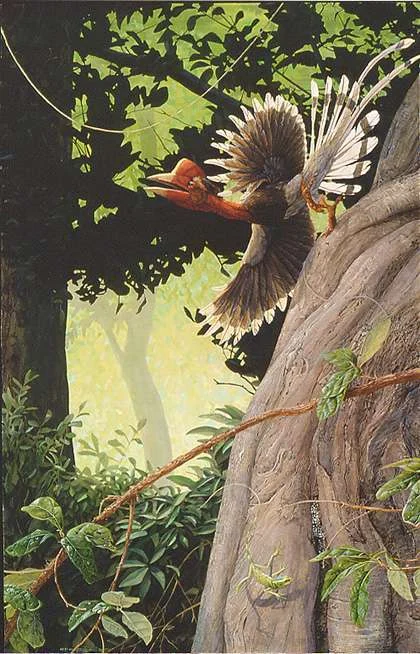
Hornbill ivory (also called golden jade or calao ivory, and ivoire rouge in French) is a precious ornamental material derived from the helmeted hornbill (Rhinoplax vigil), a large bird of the Malay Peninsula, Sumatra, and Borneo.
Many hornbill species have "casques", decorative growths on the upper mandible of the bill. In most, the casque has a spongy structure, but in the helmeted hornbill it is solid keratin. This material, hornbill ivory, has a texture suggesting ivory but is softer. As it grows it is golden yellow, but the bird rubs its casque on its preen gland, whose oily secretion tints the surface of the casque bright red.
Native peoples in the helmeted hornbill's range, such as the Kenyah and Kelabit, have long carved the casques. In Malaysia, hornbill-ivory rings were said to change colour when near poisonous food. The Chinese encountered the material in the 14th century and it soon became an important trade item at Brunei. According to Tom Harrisson, writing in the first (1960) edition of The Birds of Borneo:
It is likely that the casques were mainly exported raw, and worked with a heat treatment and pressing—of which no detailed description survives—in China, to preserve...
Many hornbill species have "casques", decorative growths on the upper mandible of the bill. In most, the casque has a spongy structure, but in the helmeted hornbill it is solid keratin. This material, hornbill ivory, has a texture suggesting ivory but is softer. As it grows it is golden yellow, but the bird rubs its casque on its preen gland, whose oily secretion tints the surface of the casque bright red.
Native peoples in the helmeted hornbill's range, such as the Kenyah and Kelabit, have long carved the casques. In Malaysia, hornbill-ivory rings were said to change colour when near poisonous food. The Chinese encountered the material in the 14th century and it soon became an important trade item at Brunei. According to Tom Harrisson, writing in the first (1960) edition of The Birds of Borneo:
It is likely that the casques were mainly exported raw, and worked with a heat treatment and pressing—of which no detailed description survives—in China, to preserve...
Sounds
A verified sound recording has not been linked yet. Auto Sync will keep checking xeno-canto and Wikimedia Commons.
References
- GBIF Auto Sync GBIF
- Wikipedia — Hornbill ivory Wikipedia
No published comments yet.